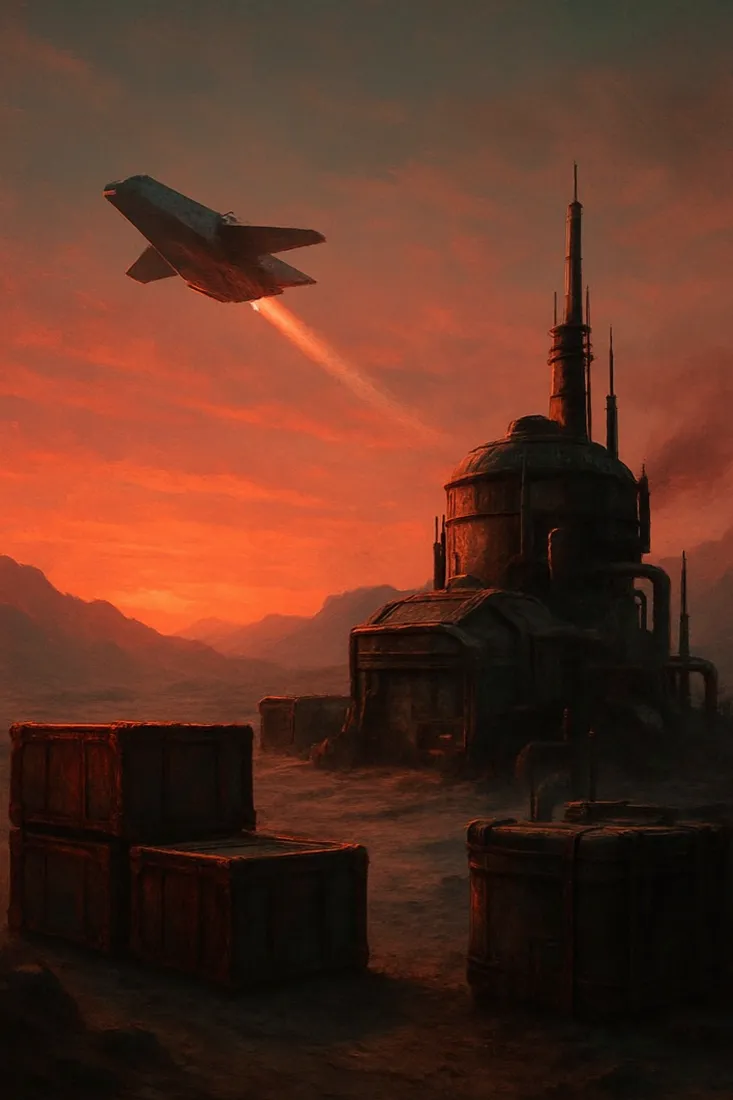
The first purchase we made in Prosperous Universe was a batch of food for our pioneers, and the ask price was a few units higher than the day before. Nobody at the developer had changed it. Another player, somewhere, had sold out and a different seller had stepped in. That small moment explains the whole game: the economy is entirely made by people, and you are now one of them.
Prosperous Universe is run by Simulogics and played through APEX, a highly customisable interface that lives in your browser. You found a company, choose a starting faction region, build a base on a planet and begin producing something other players need. There is no combat to speak of. The conflict is commercial, and it is far more gripping than that sounds.
Reading a planet before you build on it
Base placement is your first serious decision. Planets differ in atmosphere, temperature, pressure, minerals, water and terrain, and those properties decide what you can build cheaply and what you can extract. A fertile world suits farming; a mineral-rich rock suits mining. Getting this wrong is not fatal, but it is expensive, and the game makes you think like a surveyor before you think like a tycoon.
Your workforce needs looking after too. Pioneers and settlers consume food, water and other goods, and an unhappy or underfed workforce produces less. That means even a simple mining operation sits inside a web of supply. We spent our first week learning that our ore was only as profitable as the cheapest rations we could reliably buy, which is the kind of lesson that sticks.
Exchanges where the price is whatever people decide
Trading happens on commodity exchanges that run around the clock, every day of the year. Several are tied to faction regions, such as the Antares Initiative’s exchange in Antares I, NEO Charter Exploration’s in Moria, and the Insitor Cooperative’s near the fertile world Promitor in Hortus. Each develops its own character, prices and shortages, so moving goods between them can pay well.
Order books are honest and occasionally ruthless. Undercut the market and you sell quickly but thinly; price high and your stock sits. We learned more about supply and demand in a month here than in any classroom. Because every price is player-set, a sudden shortage is a real event, and spotting one early, then producing to fill it, is the purest pleasure the game offers.
Freight, fuel and the contract board
Ships matter, but as trucks rather than weapons. You can design spaceships, fit them for cargo and plan routes with fuel as the constant limiting factor. A long haul between exchanges may earn a fat margin, but only if you counted the fuel correctly. Running dry is not dramatic; it is just slow and embarrassing, which in a business game is punishment enough.
Shipment contracts let other players pay you to deliver their goods, which is the gentlest way into the economy for a new company. Taking contracts taught us routes, travel times and which goods were in demand, all while someone else carried the risk of buying. Later, we wrote our own contracts and discovered how much a reliable hauler is worth to a busy producer.
Factions, politics and a licence you can skip
Planets host political factions with their own agendas, and players can align with them or work against them to gain leverage. It is a layer that becomes interesting once your company has roots somewhere, because local politics shape infrastructure and opportunity. In the early weeks, it is mostly flavour; by the second month, it starts to feel like the town council you actually care about.
The game is free to play with an optional paid PRO Licence, and the developers state plainly that there is no pay-to-win grinding. In practice, the free tier is a complete game. The licence adds comfort and capacity rather than a shortcut, and because every commodity is still produced by a player, money cannot conjure goods out of thin air. That is rare and worth applauding.
Prosperous Universe: the opening week
- Read the starting tutorial in full; APEX looks intimidating until you learn that every window is a command you can rearrange.
- Choose a base planet whose resources match one simple product you can sell, rather than chasing the most exotic chain.
- Buy a week of consumables for your workforce up front, so production never stalls while you learn the exchange.
- Accept two or three shipment contracts to learn routes and fuel use before you trade on your own account.
- Check the exchange for a product with thin supply, and plan your second building around filling it.
What we love
- Every single commodity is player-made, so the economy feels alive and honest.
- APEX can be rearranged into exactly the dashboard your business needs.
- Shipment contracts give newcomers a low-risk route into trade.
- A free tier that is a complete game rather than a demo.
What grates
- The interface is dense, and the first hour feels like reading an accounts package.
- No real combat, so action-minded pilots will drift away quickly.
- Mistakes in base placement are slow and costly to correct.
The player Prosperous Universe is built for
This is for the player who reads patch notes for fun, keeps a spreadsheet of their own, and finds supply chains genuinely interesting. If you want lasers, look at DarkOrbit. If you want a quiet, deep business that grows while you sleep and rewards cleverness over hours, there is nothing else quite like it.
The last word on Prosperous Universe
Prosperous Universe is the most intellectually honest game on our chart. No fixed prices, no conjured goods, no pay-to-win: just a company, a planet and a market of other people. It is not for everyone and the interface asks for patience, but once you see your first margin appear because you spotted a shortage before anyone else, it becomes hard to stop checking the exchange.